
Are Manchester United sleeping giants or just taking a power nap?
For now, times are tough at Old Trafford. We have here a colossal football club with barely a faint hope of a top 4 finish this season. They’re coached by a perennially stressed Erik ten Hag, who promised riches but is living hand-to-mouth, picking up just about enough wins to avoid the sack. Under new (minority) ownership, the road ahead – be that straight and smooth or winding and bumpy – is still unclear.
There’s been barely anything positive to say about the Red Devils since Sir Alex Ferguson stepped down from his throne in 2013. There have been cup triumphs and memorable victories, but the harmonious feeling of ‘we’re on the right track’ has been seldom felt for a solid decade.
That was until a United XI of a very youthful complexion turned in the club’s most convincing performance of the season in a 3-0 win against West Ham last Sunday. There came a moment, on an advertising board for a tyre company, where the wheels on a new United era got turning.
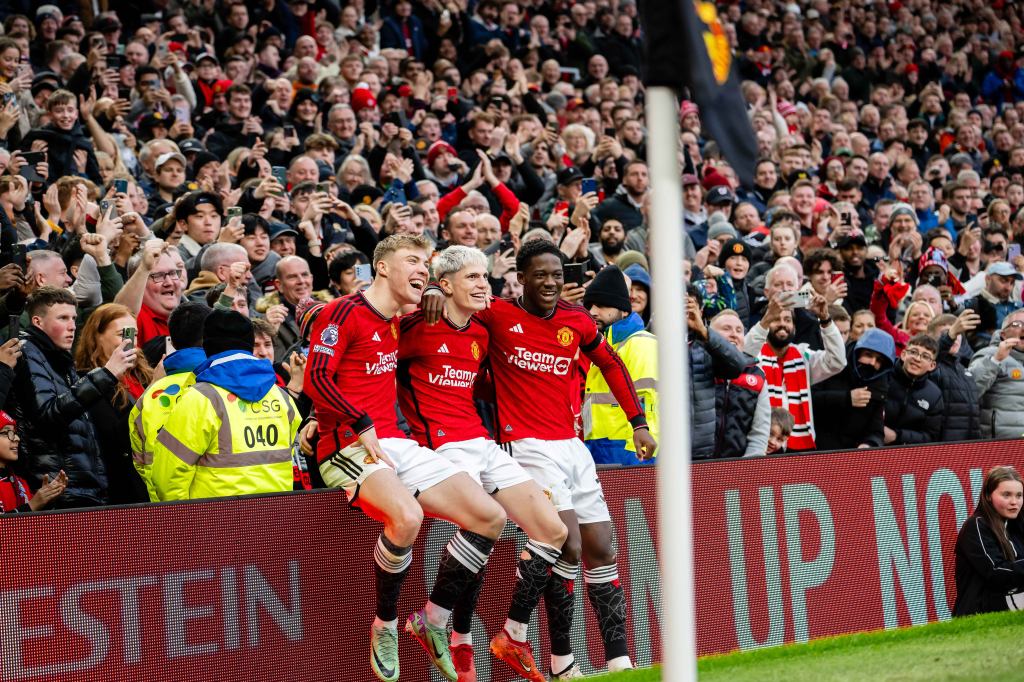
With the +3 in the bag, Ten Hag could sleep easily knowing his job status was intact for at least another week. But uninterrupted sleep wasn’t the only rare treat from the weekend. Finally, ‘hope’ was a word being bandied about the red side of Manchester. We can’t tell if this newfound optimism is naive. But it has a clear source: the joys of youth. Which, if Erik had any sense, will shape the second half of his team’s season.
So far, Erik the Red has been a different man compared to Erik of Amsterdam. The latter led Ajax to within a Lucas Moura’s hair’s breadth of the Champions League final in 2019, and lifted three consecutive Eredivise titles. The former, in year two at United, is more closed-off, exasperated and seemingly overwhelmed by all the plates he has to spin as the manager of England’s biggest football club.
There is mitigation, of course. He has had more than his fair share of man-management to do, ranging from the disquiet of Jadon Sancho to the serious legal cases involving Mason Greenwood and Anthony. His employers are the Glazer family, the target of an infinite number of rants from club legend Gary Neville (all of which are accurate). The club’s player recruitment strategy, if they even have one, has prioritised overspending on ill-fitting players. Ten Hag is a disciple of Cryuff, Van Gaal and Guardiola, but even he can’t magic up solutions to these problems. Yet it’s exactly because of his managerial pedigree that the team’s failings on the pitch have raised my eyebrows.
Ten Hag, the timid new hire, stunted his own progress last season by falsely believing that he will be judged more by his mistakes than by his initiative. The precedent was set after his team were embarrassed 4-0 by Brentford in Ten Hag’s second game in charge. Their next fixture was not quite a must-not-lose but definitely a must-not-be-thrashed versus Liverpool. Damage limitation was the order of the day, and a resolute United nicked a win against their rivals. As a one-off exercise in pragmatism this is fine. But it set the tone for the Ten Hag administration.
When United held an attacking Tottenham outfit to a 2-2 draw at Old Trafford last month, I saw nothing that pertained to a clear game plan from the home side. That is, nothing beyond praying Spurs’ high defensive line would create space for their pacey forwards to capitalise. Tottenham dominated possession but lacked bite in the absence of key attacking players. In the end, the scoreline flattered an uncreative United saved by clinical finishing from Marcus Rashford and Rasmus Hojlund.
Once an agenda-setter, Ten Hag now sets up his team purely to thwart the strengths or target the weaknesses of his opponent. That just can’t run in an Enlightenment era of football where clubs have a wealth of information and technology to drive a chosen philosophy. I’m not saying every coach has to be an ideologue – even Pep Guardiola displays ruthless pragmatism – but the most successful teams build from their own idea of how to play. Impose your vision first, then adapt it to your opponent. Even Luton Town have a distinct way of playing. It’s aerial and industrious, but it works for them.
Ten Hag’s approach this season has done both himself and his players a massive disservice. This was evidenced on Sunday when United finally took the handbrake off. Playing their natural game on the front foot, I saw things in a new light. You take a team of internationals, inject some confidence and belief, give them a framework of sound tactics, and suddenly the sum of its parts equates to its output. Makes sense, right? Even more exciting if your name is Erik and you want to be employed for another few years was that United had three fearless headline acts under the age of 21.
They say there’s beauty in the struggle. It might be the case that 2023/24 is a season of underachievement, but it may also be regarded by the football historians as a turning point for Manchester United. The season a new generation of talent found its feet. That is, after all, the main thing Ten Hag has going for him on the pitch. It runs deeper too. United’s under 18s are currently unbeatable, so there could soon be more youngsters joining Alejandro Garnacho and Kobbie Mainoo in the first team.
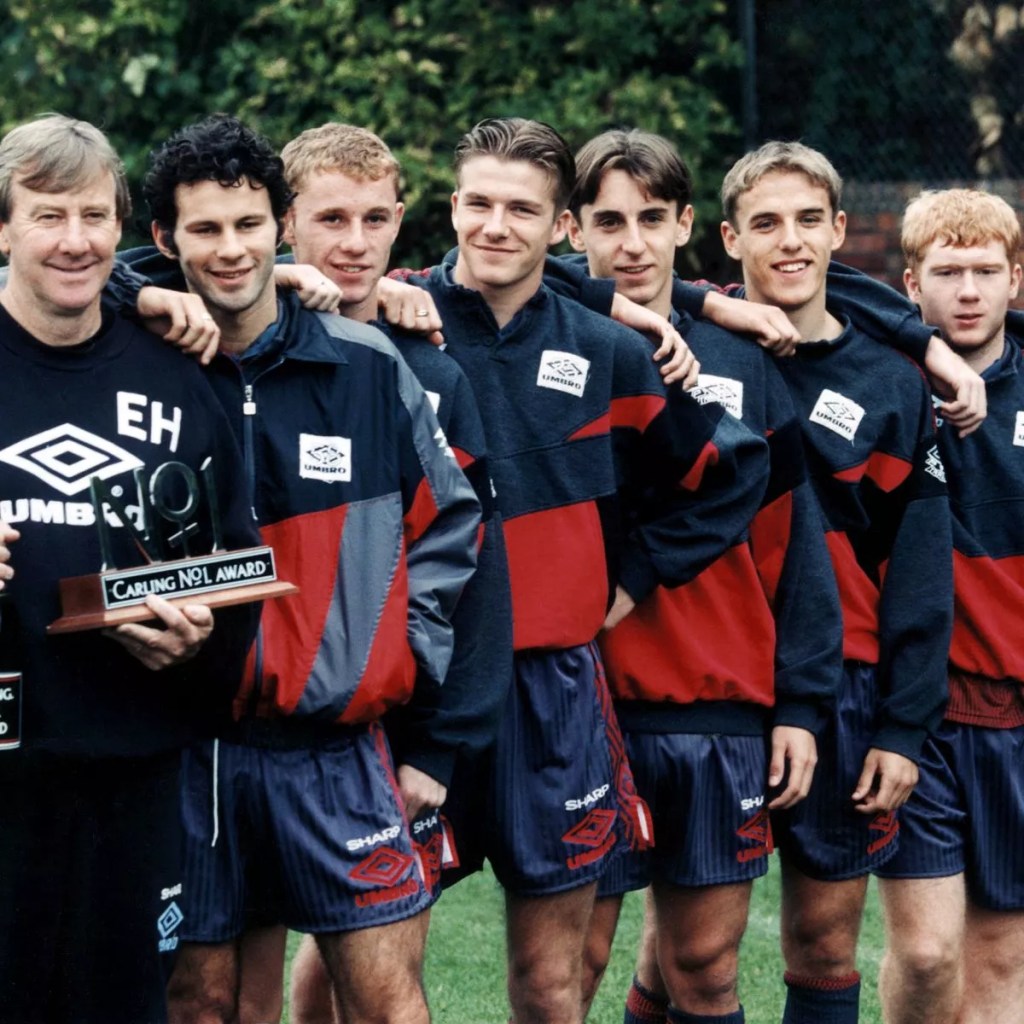
If Ten Hag previously lacked a guiding principle then he’s now got one staring him right in the face. He just needs to harness it. There are numerous reasons why he should champion the power of youth, too. The first reason, which glares down at him most matchdays, is Sir Alex. There’s no better example of a manager who stumbled around during the first few years of his tenure waiting for success. Then came the golden generation of all golden generations, the Class of ’92, which paved the way for a footballing dynasty.
There are other fine examples. Despite an FA Cup win, the jury was out on Mikel Arteta for at least the first two years of his time as Arsenal boss. ‘Lockdown Arsenal’ is something of an internet meme (though Arsenal Fan TV is largely culpable). But the light at the end of this tunnel was defined by the sprouting of young talent, in particular Bukayo Saka and Gabriel Martinelli.
Who could forget the pinnacle of Premier League youthfulness? That is, of course, the Aston Villa teams of 2012-14, who are statistically the team with the youngest average age in PL history. A 15th place finish in 2013 doesn’t jump out as success now, but Match of the Day’s Alan Hansen – notorious for his views on young teams – called for Paul Lambert to win the Manager of the Season award on account of the refreshing transformation of Villa under his stewardship.
My point is, even if you can’t win anything with kids, as a manager you sure can buy yourself some time. Fans are hardwired to back academy products as ‘one of their own’. Errors are easily forgiven, and outstanding performances are etched into a club’s history (see: Federico Macheda). It really is as simple as concluding: everyone’s happy to see a young lad playing well.
The second thing, which may be of greater interest to our Erik, is that investing in young players often produces results. It’s not an exact science, but fledgling footballers tend to play with more freedom. They’re keen to impress, have not yet been conditioned into playing a certain way, and usually don’t have to justify a heavy transfer fee or an international call-up.
Then there’s the financial side of things. Buying young and cheap is a win-win method. If a prospect makes the grade, you’ve avoided spending millions on an established player. Otherwise, he can be sold on for a profit. The wisdom of such a recruitment strategy will drive new investor Sir Jim Ratcliffe’s planned overhaul of the club. In fact, it’s in vogue at most big clubs. Chelsea and Manchester City have seemingly produced half the professional footballers in the world. Tottenham recently beat Barcelona to the signature of talented young Swede Lucas Bergvall. Whether or not he makes an appearance for the club, it’s safe to assume Spurs will make money from this.
I anticipate the ‘this is all well and good, but’ counter-argument from Man United fans. The fact is, a super-club like United can’t afford a protracted transition phase, crossing their fingers for Hojlund and co while the blue side of Manchester has all the fun.
The three-time Champions League winners have failed to qualify for said competition five times over the last decade. That’s five times too many. It’ll soon be six unless they muster a faultless run to the end of the season. Ultimately, few onlookers expect any success for United this season. But that doesn’t rule out the potential for productivity.
Erik Ten Hag has often appeared lost. Last week, while his young stars shone on the pitch, his North Star flickered ahead of him. Don’t worry United fans, there is a way forward. The future has already arrived.
 Chris Perrin