Squeaky bum time: Theatre of Dreams out, swanky megabowl in?

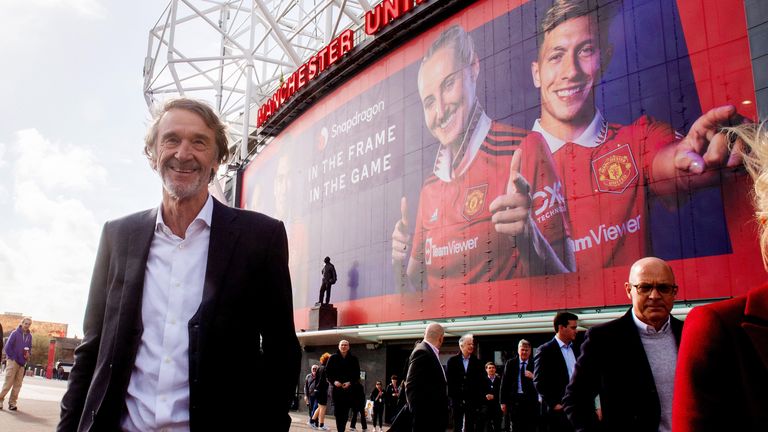
Sir Jim Ratcliffe isn’t one to shy away from big projects. That’s why he wants to knock down Old Trafford, the largest stadium in British club football, and build the – even larger – largest stadium in British club football.

It’s an ambition that divides opinion, but one that has to be viewed in the wider context of football finance. The Premier League’s new Profitability and Sustainability Rules (PSR) have thrown the cat among the big-spending pigeons. Suddenly, it’s not quite enough to have a shady oligarch or entire shady country bankroll your squad’s facelift. Revenue is king. Without enough of it, clubs are presented with an unenviable fork in the road: scrimp, or suffer a points deduction.

Old Trafford doesn’t exactly have a problem with matchday revenue – its 75,000 capacity is comfortably the highest in the league – but it’s an old stadium with mounting issues. Its roof is as leaky as United’s defen- oops, that one’s been taken. Rust and wear runs through the brickwork as much as it does the United squad (that’s more like it). Missing out as a host stadium at Euro 2028 to the noisy neighbours’ Etihad stadium underlines the ageing process of the England national team’s second home – used only once since the ‘new’ Wembley opened in 2007.

Convenient then that Ratcliffe recently declared his flagship construction project as the ‘Wembley of the North’. This managed to screw up quite a few mancunian faces, with the Oldham native not quite grasping his supporters’ self-identity in opposition to the wealth-hoarding capital city. Nevertheless, the tagline for a new 90,000 seater seems to have stuck.

The justification given by Britain’s richest man is unsurprisingly about money. It would help to make up ground lost to the league’s recent renovators. Tottenham, Arsenal, West Ham and the aforementioned Man City profit from modern, well-connected, multi-purpose stadia which can host visitors like Lady Gaga and Beyonce – far more glamourous than Burnley and Luton Town. Evidence, such as Tottenham’s 600% increase in new stadium matchday revenue, highlights a trend towards maximising sales by keeping doors open in the hours before and after a game. The new generation of match-going fans have their whole day mapped out. That’s right, red devils, get in there early. It’s wall-to-wall craft beer and banh mi.

It’s not an unrealistic task either. Like rats, you’re never further than 5 meters from a United fan at any moment. So there’s no concern about filling the extra capacity. Nor would it do any harm to regenerate Trafford Park, an area where if I’m not attending a match or a gig at Victoria Warehouse, I must be lost.

But it’s worth considering what could be lost for good if the Theatre of Dreams is bulldozed. The saying “if it ain’t broke, don’t fix it” is probably frowned upon in architecture, but the truth is that Old Trafford continues to serve its purpose well. A leaky roof isn’t a sign of imminent collapse. Knocking the whole thing down and starting again would come with an immense cost (roughly £1.2 billion) which could otherwise be spent on improving the squad. It’s perhaps coincidence that Arsenal and Tottenham reached the Champions League final the same year their new stadiums were completed. But 2006 and 2019 marked these teams’ peak before a protracted, painstaking transition period. No more marquee signings when you need to pay off the new home.

For all their differences, I’m sure fans of Spurs and Arsenal share the sweet sorrow of latter-day White Hart Lane and Highbury. After years of routine, you take your seat at your club’s Saturday fortress for the final time. It then disappears to be replaced by a swanky mega-bowl. Despite attention to detail and a focus on acoustics, the atmosphere at Spurs felt flat during most games. Thankfully, the library comparisons had already been made with the Emirates. Although I’m now giddy with excitement at my club’s spending power, the humble quirks and mystique of White Hart Lane are still missed. Lord knows how United fans will mourn the Theatre of Dreams.

Even the most fanatical of United supporters may see their fiercest rivals as an example to follow. Like Old Trafford, Anfield is one of the remaining grand cathedrals of football. Over two rounds of redevelopment spanning ten years, its capacity kept pace with the league’s leaders, growing from 45,000 to 61,000. Kopites therefore don’t have to worry about losing what is such a core component of Liverpool’s identity and ethos.

Good for them. But for all its aches and pains, moving home is an inevitability in football as it is in life. Time swallows everything, including the steelworks of your football club’s main stand. Old Trafford’s best days are far behind us, so a new stadium for a new era makes sense – you don’t need a marketing degree to see that. Ratcliffe, in the spirit of ruthless modernisation (and self-congratulation), will choose to build. Fans are understandably sentimental folk but if they had their way, would any of the decaying stadiums of the 20th century be replaced? We’d still be sat in wooden chairs drinking Bovril.

Now, where’s my pint of Neck Oil?

Ten Hag needs a guiding principle. Is youth the answer?

Are Manchester United sleeping giants or just taking a power nap?

For now, times are tough at Old Trafford. We have here a colossal football club with barely a faint hope of a top 4 finish this season. They’re coached by a perennially stressed Erik ten Hag, who promised riches but is living hand-to-mouth, picking up just about enough wins to avoid the sack. Under new (minority) ownership, the road ahead – be that straight and smooth or winding and bumpy – is still unclear.

There’s been barely anything positive to say about the Red Devils since Sir Alex Ferguson stepped down from his throne in 2013. There have been cup triumphs and memorable victories, but the harmonious feeling of ‘we’re on the right track’ has been seldom felt for a solid decade.

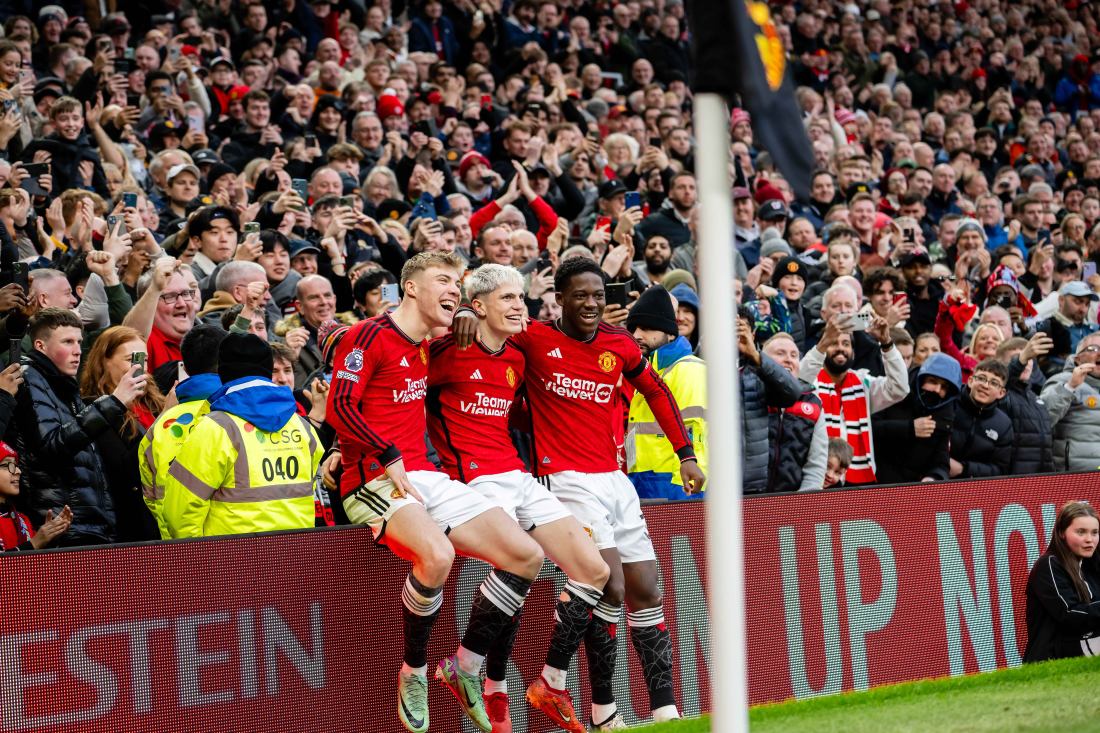
That was until a United XI of a very youthful complexion turned in the club’s most convincing performance of the season in a 3-0 win against West Ham last Sunday. There came a moment, on an advertising board for a tyre company, where the wheels on a new United era got turning.

Source: The Independent

With the +3 in the bag, Ten Hag could sleep easily knowing his job status was intact for at least another week. But uninterrupted sleep wasn’t the only rare treat from the weekend. Finally, ‘hope’ was a word being bandied about the red side of Manchester. We can’t tell if this newfound optimism is naive. But it has a clear source: the joys of youth. Which, if Erik had any sense, will shape the second half of his team’s season.

So far, Erik the Red has been a different man compared to Erik of Amsterdam. The latter led Ajax to within a Lucas Moura’s hair’s breadth of the Champions League final in 2019, and lifted three consecutive Eredivise titles. The former, in year two at United, is more closed-off, exasperated and seemingly overwhelmed by all the plates he has to spin as the manager of England’s biggest football club.

There is mitigation, of course. He has had more than his fair share of man-management to do, ranging from the disquiet of Jadon Sancho to the serious legal cases involving Mason Greenwood and Anthony. His employers are the Glazer family, the target of an infinite number of rants from club legend Gary Neville (all of which are accurate). The club’s player recruitment strategy, if they even have one, has prioritised overspending on ill-fitting players. Ten Hag is a disciple of Cryuff, Van Gaal and Guardiola, but even he can’t magic up solutions to these problems. Yet it’s exactly because of his managerial pedigree that the team’s failings on the pitch have raised my eyebrows.

Ten Hag, the timid new hire, stunted his own progress last season by falsely believing that he will be judged more by his mistakes than by his initiative. The precedent was set after his team were embarrassed 4-0 by Brentford in Ten Hag’s second game in charge. Their next fixture was not quite a must-not-lose but definitely a must-not-be-thrashed versus Liverpool. Damage limitation was the order of the day, and a resolute United nicked a win against their rivals. As a one-off exercise in pragmatism this is fine. But it set the tone for the Ten Hag administration.

When United held an attacking Tottenham outfit to a 2-2 draw at Old Trafford last month, I saw nothing that pertained to a clear game plan from the home side. That is, nothing beyond praying Spurs’ high defensive line would create space for their pacey forwards to capitalise. Tottenham dominated possession but lacked bite in the absence of key attacking players. In the end, the scoreline flattered an uncreative United saved by clinical finishing from Marcus Rashford and Rasmus Hojlund.

Once an agenda-setter, Ten Hag now sets up his team purely to thwart the strengths or target the weaknesses of his opponent. That just can’t run in an Enlightenment era of football where clubs have a wealth of information and technology to drive a chosen philosophy. I’m not saying every coach has to be an ideologue – even Pep Guardiola displays ruthless pragmatism – but the most successful teams build from their own idea of how to play. Impose your vision first, then adapt it to your opponent. Even Luton Town have a distinct way of playing. It’s aerial and industrious, but it works for them.

Ten Hag’s approach this season has done both himself and his players a massive disservice. This was evidenced on Sunday when United finally took the handbrake off. Playing their natural game on the front foot, I saw things in a new light. You take a team of internationals, inject some confidence and belief, give them a framework of sound tactics, and suddenly the sum of its parts equates to its output. Makes sense, right? Even more exciting if your name is Erik and you want to be employed for another few years was that United had three fearless headline acts under the age of 21.

They say there’s beauty in the struggle. It might be the case that 2023/24 is a season of underachievement, but it may also be regarded by the football historians as a turning point for Manchester United. The season a new generation of talent found its feet. That is, after all, the main thing Ten Hag has going for him on the pitch. It runs deeper too. United’s under 18s are currently unbeatable, so there could soon be more youngsters joining Alejandro Garnacho and Kobbie Mainoo in the first team.

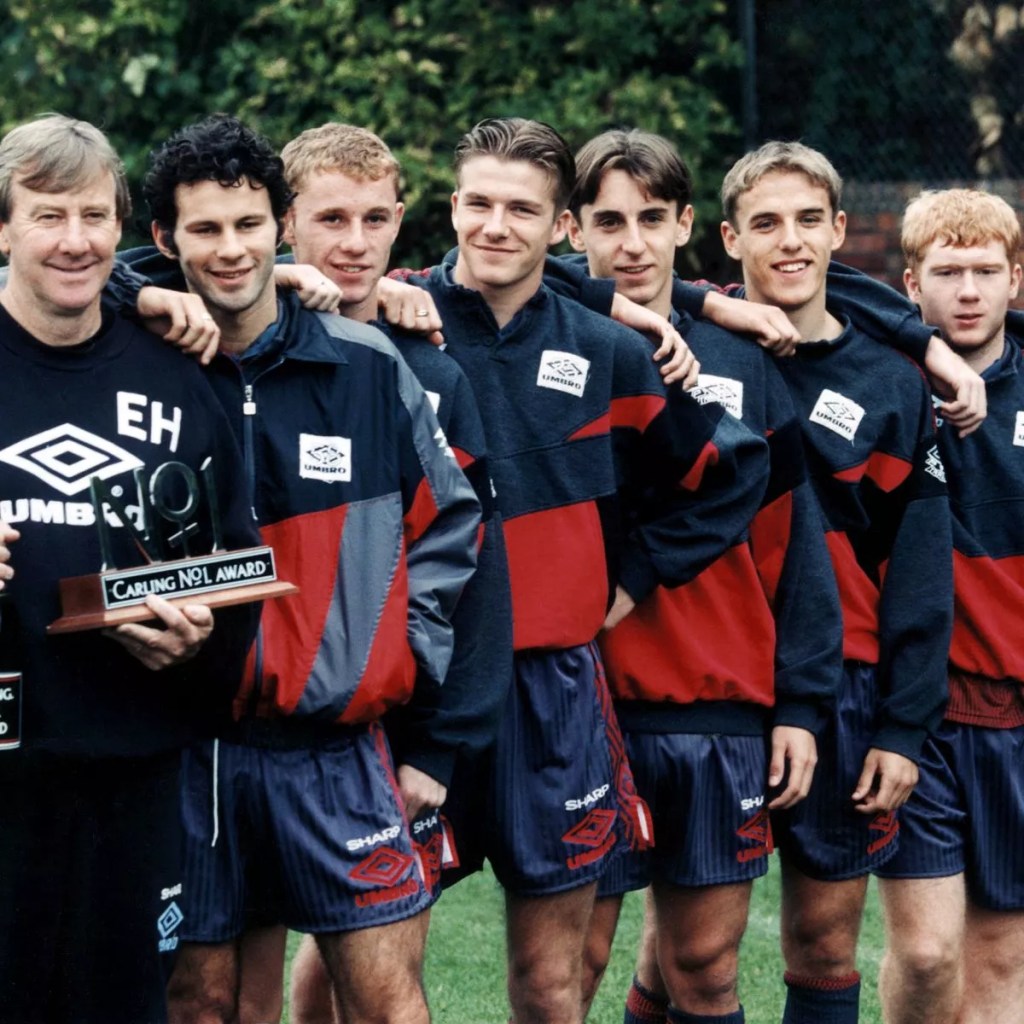
If Ten Hag previously lacked a guiding principle then he’s now got one staring him right in the face. He just needs to harness it. There are numerous reasons why he should champion the power of youth, too. The first reason, which glares down at him most matchdays, is Sir Alex. There’s no better example of a manager who stumbled around during the first few years of his tenure waiting for success. Then came the golden generation of all golden generations, the Class of ’92, which paved the way for a footballing dynasty.

Source: The Mirror

There are other fine examples. Despite an FA Cup win, the jury was out on Mikel Arteta for at least the first two years of his time as Arsenal boss. ‘Lockdown Arsenal’ is something of an internet meme (though Arsenal Fan TV is largely culpable). But the light at the end of this tunnel was defined by the sprouting of young talent, in particular Bukayo Saka and Gabriel Martinelli.

Who could forget the pinnacle of Premier League youthfulness? That is, of course, the Aston Villa teams of 2012-14, who are statistically the team with the youngest average age in PL history. A 15th place finish in 2013 doesn’t jump out as success now, but Match of the Day’s Alan Hansen – notorious for his views on young teams – called for Paul Lambert to win the Manager of the Season award on account of the refreshing transformation of Villa under his stewardship.

My point is, even if you can’t win anything with kids, as a manager you sure can buy yourself some time. Fans are hardwired to back academy products as ‘one of their own’. Errors are easily forgiven, and outstanding performances are etched into a club’s history (see: Federico Macheda). It really is as simple as concluding: everyone’s happy to see a young lad playing well.

The second thing, which may be of greater interest to our Erik, is that investing in young players often produces results. It’s not an exact science, but fledgling footballers tend to play with more freedom. They’re keen to impress, have not yet been conditioned into playing a certain way, and usually don’t have to justify a heavy transfer fee or an international call-up.

Then there’s the financial side of things. Buying young and cheap is a win-win method. If a prospect makes the grade, you’ve avoided spending millions on an established player. Otherwise, he can be sold on for a profit. The wisdom of such a recruitment strategy will drive new investor Sir Jim Ratcliffe’s planned overhaul of the club. In fact, it’s in vogue at most big clubs. Chelsea and Manchester City have seemingly produced half the professional footballers in the world. Tottenham recently beat Barcelona to the signature of talented young Swede Lucas Bergvall. Whether or not he makes an appearance for the club, it’s safe to assume Spurs will make money from this.

I anticipate the ‘this is all well and good, but’ counter-argument from Man United fans. The fact is, a super-club like United can’t afford a protracted transition phase, crossing their fingers for Hojlund and co while the blue side of Manchester has all the fun.

The three-time Champions League winners have failed to qualify for said competition five times over the last decade. That’s five times too many. It’ll soon be six unless they muster a faultless run to the end of the season. Ultimately, few onlookers expect any success for United this season. But that doesn’t rule out the potential for productivity.

Erik Ten Hag has often appeared lost. Last week, while his young stars shone on the pitch, his North Star flickered ahead of him. Don’t worry United fans, there is a way forward. The future has already arrived.

Crystal Palace: the football club about nothing

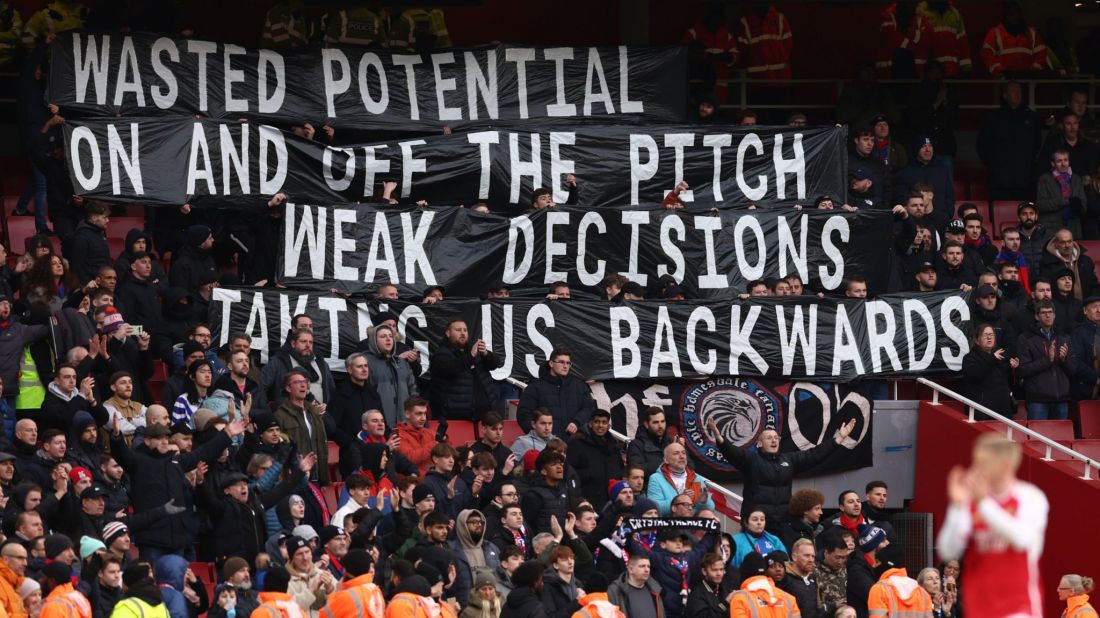
The protestations of Crystal Palace fans at the Emirates this weekend felt overdue. But then so do a lot of things at Palace, such is the uneventfulness of their existence. Barely a day goes by where I do think of Crystal Palace. Yet the situation at the club is now heating up to boiling point. The supporters clearly aren’t happy, and it’s worth considering why.

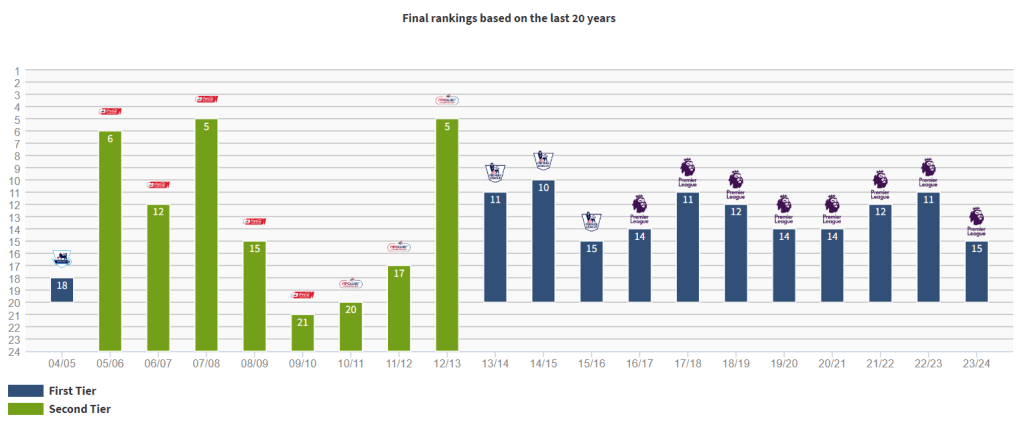
Crystal Palace are, on closer inspection, one of the most fascinating clubs in the Premier League. They are currently busying their way through their tenth consecutive season in the top flight, in the very manner they did for the previous nine. In those ten years, Palace have finished no higher than tenth, and no lower than fifteenth. They’ve never flirted with Europe and have avoided being serious relegation candidates. It’s a record so unremarkable, it’s remarkable.

Source: Transfermarkt

If the Premier League table was the M1, with every team quickly headed north or south, Palace would be loitering in a service station just outside Leicester. But their occupation of this anonymous lower-middle section of the table has not been as boring or bleak as it suggests.

Think of Andros Townsend at the Etihad, Dwight Gayle crushing scouse dreams, or Alan Pardew’s Wembley boogie. Palace have entertained. In Marc Guéhi, Aaron Wan-Bissaka and – unquestionably – Wilfred Zaha, some of the country’s best young talent has emerged at Selhurst Park. Speaking of, being a spectator there is often a fantastic experience, even when the game itself doesn’t match it. Palace supporters home and away are as passionate and devoted as you’ll get.

Right now, they’re definitely not glad all over. And I can totally see why. If I was a Palace fan, I would be looking around enviously at other Premier League clubs of similar stature who have managed to climb higher. Seagulls aren’t supposed to outfly Eagles, yet the trajectory of rivals Brighton – who not long ago were playing at a small-time athletics track – has been steeper and more inspiring.

‘Wasted potential on and off the pitch. Weak decisions taking us backwards’ is what the banners read on Saturday.

This definitely rings true. Crystal Palace are the league’s resident make-doers. Their life cycle goes like this: develop and sell talented young players, reinvest within their means, beat a Big 6 team under the lights at Selhurst, finish between tenth and fifteenth. Repeat.

Contentment with this routine points to a lack of ambition. So in that regard, supporters are right to feel short-changed. Shouldn’t ten years in the top flight merit more than this? We can’t know for sure what the winning fans at the 2013 playoff final expected, but it certainly wasn’t stagnation.

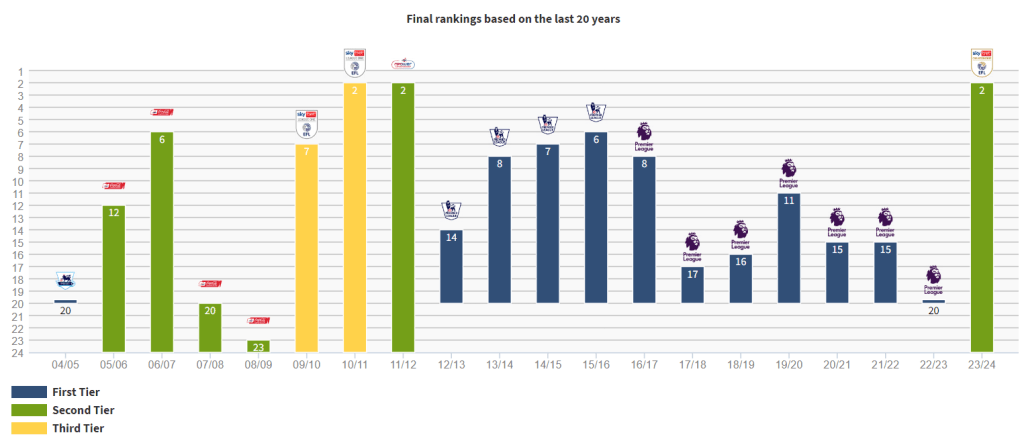
The worry amongst supporters must be in part due to the fine margin between comfortable mid-table finishes and relegation. The precedent set by Southampton exemplifies how Premier League status cannot be taken for granted. Following four top-half finishes and a taste of European football the Saints got complacent and wobbled around the wrong half of the table. Ralph Hasenhüttl steered them away from danger until he could no longer. In 2022/23 he got the sack, and Southampton hit rock bottom.

Source: Transfermarkt

The truth is that Southampton were a ticking time-bomb for five seasons before their eventual demise. There just happened to be three worse teams in the league. You can make a fair case that Crystal Palace have now taken on that mantle. Swap out Hasenhüttl, and it’s Roy Hodgson as the competent but limited caretaker.

Roy spoke diplomatically after Saturday’s embarrassing defeat. If he’s sacked anytime soon there could be a job for him in the Foreign Office. It’s not like retirement appeals to the veteran coach.

“All I would say is they (the fans) are totally entitled to their opinion. I do understand their frustration, even anger and disappointment that things haven’t got better… If we are going to go forward and avoid relegation and do well, we need these fans with us. Hopefully we can keep them on board and the best way to do that is by winning football matches and playing better than today.”

It wouldn’t surprise me if it was another manager who carried out the tasks Hodgson outlines. The unemployed Graham Potter, responsible for Brighton’s aforementioned rise, was in attendance at the Emirates.

But to give Hodgson his due, there is an alternative way of viewing Palace’s situation.

The Premier League is a beast. It will happily chew up and spit out any team that takes a couple of missteps. In fact, since Palace came up in 2013 twenty clubs have also celebrated promotion. Of those twenty, only ten are in the Premier League this season. So we’re talking about a 50% chance of survival.

Break it down further, and you can deduce three subcategories of promoted club:

  1. Established PL outfits: Newcastle, Brighton, Aston Villa, Wolves, Brentford.
  2. Unsettled PL status: Leicester, Burnley, Bournemouth, Watford, Middlesbrough, Fulham, Leeds, Norwich, West Brom, Sheffield United, Luton, Nottingham Forest.
  3. Not seeing them in the PL anytime soon: QPR, Huddersfield.

Where do Palace fit? Based on the evidence it has to be the ‘established’ section. But their PL status appears more precarious than the other five, perhaps with the exception of Brentford.

For all the tedium and moans and groans concerning the last ten years, the bottom line is Crystal Palace have fared much better than the promoted clubs who are now jostling for what Palace have: stability.

Should Palace fans not instead reflect on the ten years preceding 2013, rather than the ones following? After all, they so nearly suffered the same fate as clubs like Charlton, Portsmouth and Bolton. If you thought QPR and Huddersfield had it rough, try plotting an escape from League One. Two points kept debt-stricken Palace away from the third division in 2009/10 following a points deduction, and we could so easily have never spoken about them as a Premier League team again for a long, long time.

That lived experience is probably what influences the judgement of chairman Steve Parish and sporting director Dougie Freedman, the latter of whom is a club legend who played and managed at Selhurst Park during their Championship years.

Of course, Crystal Palace could break convention: hand over the keys to John Textor, deploy a ‘Moneyball’ recruitment strategy, go for broke and finally breach Europe. But that project could so easily go down in flames. Parish and Freedman probably see it that way too, and thus battle on knowing they will just about have enough to stave off relegation for another year. This season, it would be the first without the talismanic Wilfried Zaha.

It all comes down to the one thing every football club craves. No, not trophies. Stability. That key word again. Mauricio Pochettino once infuriated Spurs fans and made a meme of himself by likening top-four finishes to trophies. But he had a point. The same notion was more eloquently worded by new Tottenham boss Ange Postecoglou ahead of his first FA Cup match. He effectively said the end goal should not be the silverware itself, but positioning the club to compete for silverware on a regular basis. Palace might still be some way off that, but success is relative.

What does the future hold for them? Palace could be West Ham or Brentford, capitalising on their geographical placement to grow their club and looking up the table rather than over their shoulders. But by the same token, they could be Milwall or Charlton – the forgotten quarters of London football – stuck and frustrated lower down the pyramid.

The enlightened view may be that fans care about how stability is achieved. Villa have been propelled by an elite manager who gets results. Brighton have cracked player recruitment. Newcastle have a bottomless pit of petrostate funds. Whichever way it’s done, all three examples speak to purposeful improvements. A clear line of sight in an upward direction. Were Palace to find their own version, they could finally secure that coveted ninth place finish. Accomplish that, and for the Eagles the sky could be the limit.

Arsenal and the crushing weight of near-success

Time moves way too quickly in football.

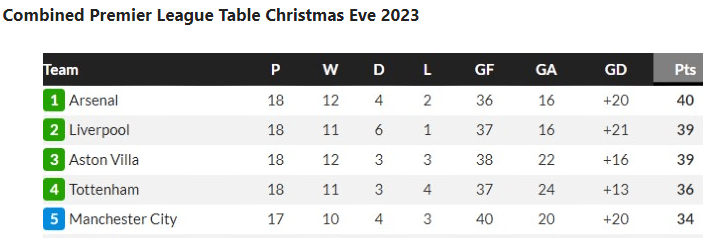
On Christmas Day, Arsenal were top of the Premier League having earned a more-than-respectable point at Anfield. ‘Top at Christmas’, a purely symbolic accolade, is nonetheless a firm indicator that a team are title contenders.

Fast forward two weeks from Christmas. Arsenal have lost all three games they have played, scored just once, and are engulfed in a ‘crisis’. A small, forgetful minority of Arsenal fans (presumably the ‘Amnesiac Army’) are calling for Mikel Arteta’s head.

I’m a Tottenham fan, so Arsenal’s long-overdue meeting with cataclysm does, in one sense, fill me with joy. And I could jump on the bandwagon. Yes, definitely sack Arteta! Get rid of Bukayo Saka too, he’s useless!

But I also observe this with intrigue and empathy. Arsenal seem to be suffering a case of ‘near-success syndrome’.

1: what crisis?

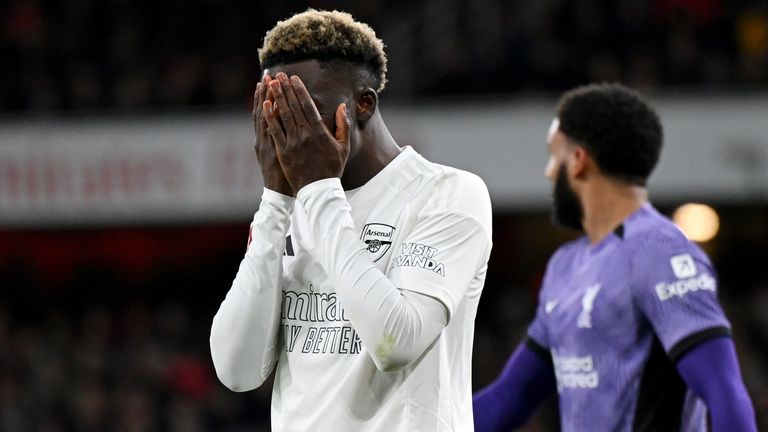
At present, the press is rife with criticism of Arsenal, as well as reasons and remedies for their recent failings. ‘We need a killer’, says Ian Wright, essentially describing himself in the 1990s. Arsenal have ‘killed William Saliba’s love for the game’, speculate Sport Bible with just a hint of exaggeration. Even Arteta himself fears his attackers have ‘mental block’.

Reactions like these aren’t unfounded, but they are overblown. Arsenal are obviously having issues in front of goal, but at Christmas, i.e. three games ago, Arsenal had scored 36 PL goals in total – just one fewer than Liverpool and four fewer than Manchester City. They also had the joint-second best goal difference in the league, and had scored 3+ goals on seven occasions in all competitions.

So clearly then, it wasn’t long ago when Arsenal’s supply of goals was healthy, and helped by their defence keeping it tight at the other end of the pitch.

And yet I was led to believe that Arsenal’s forwards couldn’t hit a barn door and that, given the circumstances, paying £100 million for Ivan Toney was ‘sensible’ and ‘the price of success these days’. That’s not to speak disparagingly of Toney, who I would take at Spurs in a heartbeat. But for that money, it would be the kind of short-sighted deal for a player who hasn’t kicked a ball in eight months that invariably backfires.

The situation at Arsenal still feels quite disastrous though, doesn’t it? Even if it probably isn’t.

2: last season was mad close

Perhaps the cause of this malaise is the psychological impact of near-success.

We need to remember how good Arsenal were for so much of 2022/23 before, tragically, ending the season trophy-less.

At Christmas last year, Arsenal had taken 37 points from 14 games. That’s points dropped in just two matches. They were comfortably the league’s best team for eight out of ten months. For the first time since 2013/14, Spurs were beaten home and away by their North London rivals. The 0-2 at our place was one of the biggest NLD non-contests I can remember.

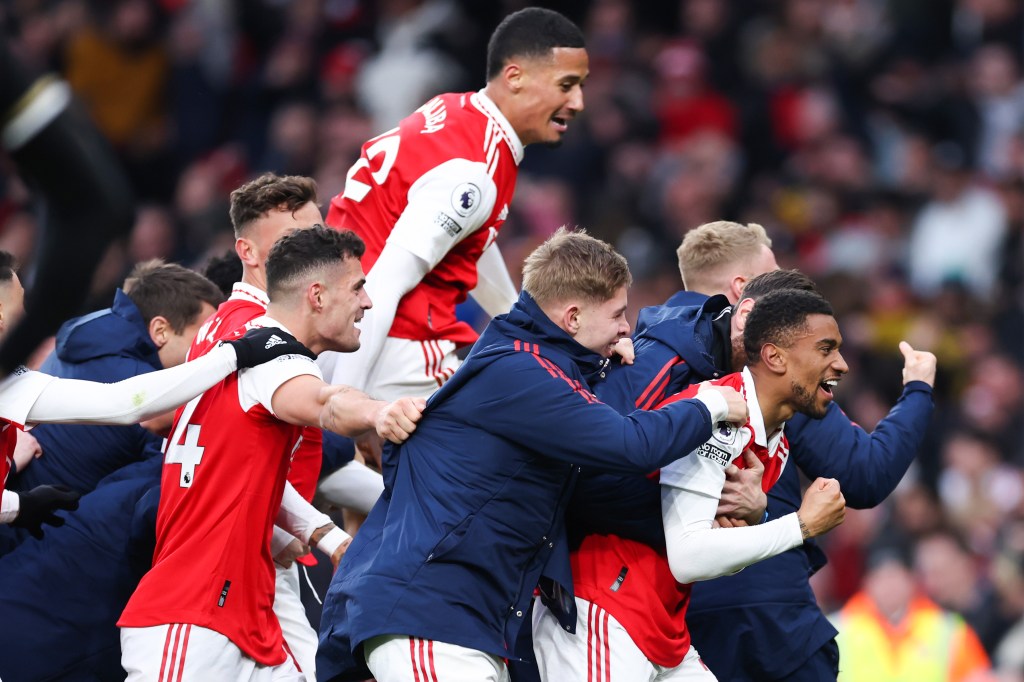
04 March 2023, London – Premier League Football – Arsenal v Bournemouth – Reiss Nelson of Arsenal celebrates their third goal with his team mates – Photo: Jacques Feeney / Offside.

The bottom line is, Arsenal hit terminal velocity and practically every single squad member was playing out of his skin. They were dancing their way to success to the tune of the Saliba chant.

But that success never came. We all know what happened and sadly for the Gooners of this world, it wasn’t even that big a down-turn in results. ‘Bottlers’ is an overused term, and does not apply to Arsenal in 2022/23. It’s nigh-on impossible to win every game, and invincibility is – well, I’ll stop right there.

No one can say Arteta stood still in the summer either. The state of his squad was, on paper at least, stronger in August than it had been in May. The £100 million spent on Declan Rice looked to be (and still could be) the difference between first and second.

But no amount of money can pay off the psychological deficit Arsenal plummeted into last season. I say this because it must be so challenging, even for the hardiest of athletes, to reach what is seemingly your absolute best and still stop short of victory. More so in a collective sport where there are additional parts involved.

3: empathy

Let’s put it this way: I have been conditioned to block out anything close to a positive thought about Arsenal. Yet it was hard not to like their team. Bukayo Saka was England’s best performing player. Martin Odegaard, rejected by Real Madrid, had fulfilled his huge potential which for years looked misplaced. Reiss Nelson scored one of the great last-minute winners against Bournemouth, and my feelings of contempt and dread (it had the air of a title-winning moment) were strangely mixed with admiration. What a goal and what a moment.

I mentioned empathy before, and I did so because Tottenham have experienced similar. In the 2018/19 season, my team looked to have performed every possible footballing miracle to reach the Champions League final. It was such a pinch-yourself scenario – the kind of pie in the sky ambition you never think is actually going to happen.

As brilliant and unexpected that journey was, I look back on it with a bitter sweetness that poses the same question Arsenal currently ponder. How do you better your best?

What followed, after the loss, was the worst kind of comedown: intense and long-lasting. Many of the players who were instrumental during Tottenham’s run to the final were shadows of their former selves. We were, let’s face it, rubbish, and continued to be rubbish for another four years. From the starting XI in the CL final, only Heung-min Son is still at the club. The manager lasted four months. There’s no doubt about the mental toll that the defeat took on the squad and staff, and some former players have attested to this.

4. monkeys and elephants

There are two possible prizes for second place. One is hope, the dream of going one further in the future. The other is an existential crisis, at the core of which is the anxiety that you’re at the ceiling and can go no higher. Arsenal started this season with the former, but risk allowing the latter to take over with this dip in form. There’s a monkey on their back and it needs to be shaken off quickly.

But more important than the monkey in this room is the big, sky-blue elephant: Manchester City.

Last season, Arsenal were the latest in a line of unsuccessful rebels to contest City’s Premier League hegemony, which has stood since Pep Guardiola’s first of five titles came in 2018.

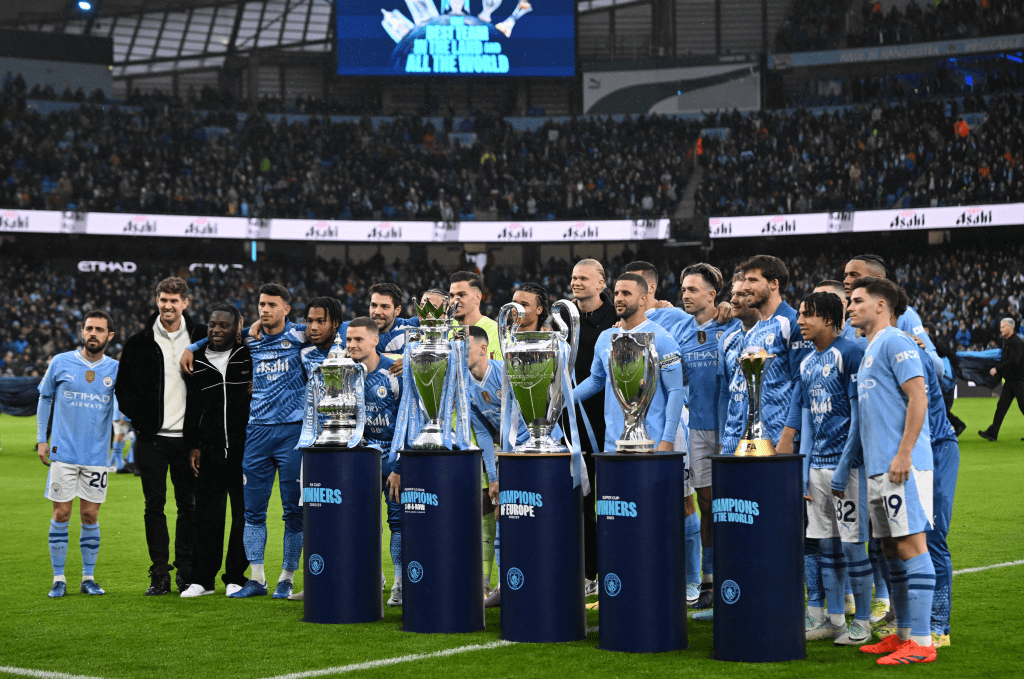
There is a more devastating complexion to City’s dominance than anything Sir Alex Ferguson ever built with his great Manchester United teams. United, even during their two Premier League peaks, traded blows with other clubs – mainly Wenger’s Arsenal and Mourinho’s Chelsea – and were knocked down. Never did United’s power appear absolute. With City, who flaunted five major trophies to their faithful at the end of 2023, it feels different.

You can view Guardiola’s City in one of two ways. There’s the Star Trek version, which is a vision of Man City as a vessel of football discovery, going where no team has gone before, constantly innovating the tactical rules of the game. Full-backs are wingers. Full-backs are midfielders. Full-backs are centre-backs. Centre-backs are midfielders. ‘We cannot replace him’, so Sergio Aguero for some time is not replaced. Then the False 9 becomes the Most 9 you can get, and Erling Haaland subsequently elevates City to an even higher level.

For the more cynical among us, there’s the Star Wars vision. Pep, obviously, is Darth Vader. The Death Star represents the City Football Group, using its endless resources – harvested from an ethical minefield – to mow down the rest of the footballing galaxy. The fact that Guardiola mentored Arteta makes this even more of a compelling analogy – Mikel, I am your father.

Manchester City’s stranglehold of English football is such that it would take something miraculous to dethrone them, which Arsenal so nearly conjured up. But if you shoot for the king, you best not miss.

Arsenal are, right now, hyperconscious that their best chance to do that may have passed. That realisation has tainted what was otherwise an assured first half of the season. How they manage the crisis from here will have a huge bearing on the second half. Use the force, Mikel.

Football is back and as boring as ever

100 days. 3 months. Bloody years! The time we’ve waited for the return of Premier League football has perhaps even felt incalculable. For something so cherished in so many of our lives to have disappeared for so long… a pat on the back for everyone is well and truly merited.

And I believe another pat on the back is required for all those who endured 180 minutes (factor in all those bloody drinks breaks too) of mind-numbing football last night without succumbing to equally mind-numbing amounts of alcohol. This is because, despite being given the time to forget, we were all reminded last night of how uninteresting our beloved sport can be.

Both games were, for want of more action and a better word, boring. Unfortunately this remained true with or without crowd noises. I’m sure we all experimented with both, and chose between what was the better of too eerie and too mimic-y.

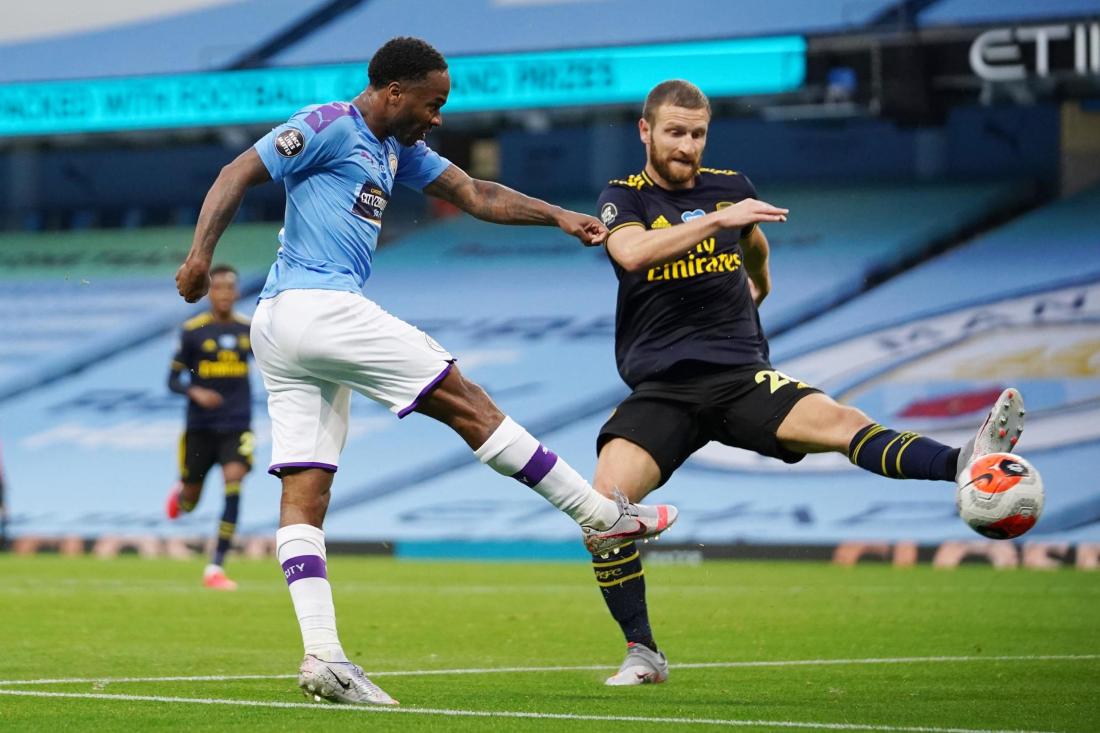
That is not to say there was absolutely nothing exciting that happened. We got to revel in the ridiculousness of VAR and technological officiating. We awed at Manchester City’s beautiful attacking moves. We all laughed at the idiocy of David Luiz.

For all the excitement of these things, there is as much predictability. Therein lies the problem. VAR is back to dominate conversations (in the Midlands and West Yorkshire for now, expect it to spread southwards soon). City are still extremely good. David Luiz is still extremely bad. We knew this!

I’m not quite sure what I was expecting. Some sort of interesting narrative? An exciting backdrop in front of which these games – all viewable live – are to be played? Oh wait, there is.

Aston Villa are still in an awfully precarious position, despite possessing a visibly talented team. They should have lost in theory, but posed much more of an attacking threat and had three times the attempts Sheffield United had. Sheffield United are, for all intents and purposes, the biggest overachievers of the season so far. But the level of quality they have shown must be maintained. An emphatic win for Manchester City renders their ground the most likely location for Liverpool to secure the title. Arsenal looked hopeless but have played no games more than anyone else and could still earn a Champions League place. Every single player and referee participated in a momentous display of solidarity to black people. And that was just one night.

Despite what some may think, no team is yet relegated or promoted. Some teams are winning the race, but have not yet won. Some are sitting in mid-table, supposedly with nothing to gain or lose, but that could also change.

This is, I suppose, why we’re here with no crowds, awkward fist-bumps and pointless drinks breaks (did I mention that?). This season had to be completed. There is still so much to play for. If you don’t like it, tough! Roll on a summer of football.

Liverpool did not need a rebuild to become serial winners. The same can happen at Spurs.

Some football matches stand out as turning points in two club’s paths.

The last time Tottenham beat Liverpool was in October 2017, a resounding 4-1 victory at Wembley.

Perhaps ‘turning point’ is too strong a term. Rome wasn’t built in a day, and neither was this current Liverpool team. But like Trajan in his heyday, Klopp and his team today are European conquerors. Not to mention the thirteen-point cushion they’re sitting on so comfortably at the top of the Premier League, plumped by a game in hand. Not even Trajan could manage that.

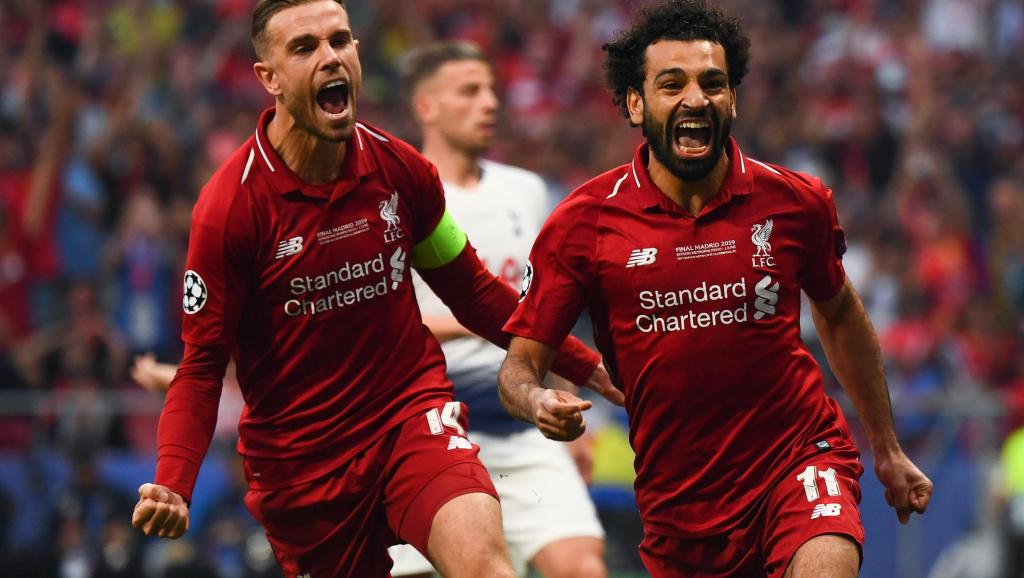
Spurs were Liverpool’s opponents in the Champions League final just six months ago, but the ironic truth is that our squad has regressed in the past two years, while Liverpool’s has gone from strength to strength. The Reds have lost just one league game since the start of last season. In the same period, Spurs have lost twenty.

Liverpool’s ascendancy has taken some five years to materialise. For at least the first two of those years, they and Tottenham were following the same trajectory. Both squads were young and packed with potential. Klopp and Pochettino were emblematic of a new breed of manager; paternalistic with their squad and philosophical with their playing style. Both teams passed it out short from the back, and pressed high up front. They were exciting projects. Breaking the top four was the first step along the way to future glory.

Evidently, Liverpool have since fared much better. But hark back to that Sunday afternoon in October 2017, and most would have cast a brighter light on the future of the Pochettino project. That project is no more. José Mourinho has inherited a squad that has looked completely out of sorts this season.

So why have things turned out that way? How are Liverpool so good? Why are Tottenham not as good?

In what’s to come, I’ll draw comparisons between that Liverpool side that was defeated then and the Tottenham team today. These similarities, if you’re as optimistic as me, show that Spurs with the right investment and leadership can still achieve great things.

First, let’s remind ourselves of the Liverpool starting eleven beaten that day:

(4-3-3) Mignolet, Gomez, Matip, Lovren, Moreno, Milner, Henderson, Can, Salah, Firmino, Coutinho

Only four of these players (Mignolet, Moreno, Can and Countinho) have since departed the club. The house hasn’t been knocked down and rebuilt. The core of the team and its formation remains the same.

What Liverpool have done so well is identify and address their weak areas. Look at that team and three areas of weakness should jump out straight away: goalkeeper, full backs, midfield.

These are, conveniently, Tottenham’s three weakest areas at present. Many supporters are calling for a complete rebuild at the club, but here I suggest that by investing smartly to address those weak spots, it may just provoke a transformation.

Between the sticks

My opinion of Hugo Lloris has rested firmly on the fence for most of his time at Spurs. He merits a lot of respect, of course. He is a World Cup winning captain and one of the best shot stoppers in the game. His penalty saves against Aguero and Aubameyang last spring prevented our season from unraveling.

Lloris has held down the no.1 spot at Spurs without question for almost seven years now, yet it feels like he has given me a mini-heart attack every other game. Since the 2017/18 season he has made 8 errors leading to goals. This sticks out like a sore thumb in comparison to the other goalkeepers of the ‘Big Six’. It is even double the errors made by David De Gea; he himself has experienced his lowest dips in form during the past two seasons.

Unfortunately, part of the job description as the last line of defense is that any mistake will likely lead to a goal. All keepers make them. The difference is with Lloris is that in 2019 he was still making the same kind of mistakes he was making at the start of the decade: rushing too far off his line, getting caught on the ball by opposition strikers. These are worrying signs.

So is Lloris a world-class keeper who makes the occasional bad decision? Or has he now been cut adrift from the elite level of keepers for good? Aged 32, and recovering from the worst injury of his career (sustained while conceding a calamitous goal), the signs sadly point to the latter.

If Lloris is to be fazed out of the club, Mourinho is left with a stick-or-twist. In the captain’s absence, Paulo Gazzaniga has been a very capable stand-in. But could he be more than that?

The Argentine has kept just one clean sheet in fifteen league appearances this season, conceding a relatively leaky 1.46 goals per game. That being said, his save success of 70% is up there with the best in league.

Number crunching can, for all its merits, be numbingly boring. It also cannot paint the whole picture. Watch Gazzaniga’s performances recently and you’ll see a keeper growing in confidence, with sound distribution and reflexes. But you will also be left feeling not entirely convinced. The mistakes made at Old Trafford and more recently at home against Chelsea are the sort that the best keepers don’t make.

When it became apparent that neither Karius nor Mignolet could cut it at the elite level, Liverpool entered the market for a world class goalkeeper. In Alisson Becker they now have the best in the world. Though he may not be winning games on his own, it makes a world of difference when a defensive line can trust the man behind them. He is a vital part of a team that currently seems unbeatable.

Obviously, it’s not as easy as that. ‘Going and buying a top keeper’ is a risky business. The £80m fee Chelsea paid for Kepa Arrizabalaga is probably the only thing that separates him from Paulo Gazzaniga at the moment. I wouldn’t swap the two if I could, though maybe that says more about Kepa’s misfortunes.

Either way, Mourinho will be faced with a difficult decision once Lloris returns from injury. While Gazzaniga has made a case to be the new no.1, both keepers have shown signs that the spot shouldn’t be designated to either of them – especially if Tottenham want to have one of the most water-tight defences in the world.

Full-backs

At the apogee of Pochettino’s tenure, his team were absolutely ruthless going forward. Tottenham topped the scoring charts in 2016/17 with 86 goals. Opposition teams faced full-frontal assaults; 11 of our victories were by at least a three-goal margin. Harry Kane ran away with the golden boot. Dele Alli and Heung-Min Son’s tallies were also well into the teens.

Much of the praise went to the forwards, but the attacking energy of that team was in large part facilitated by Kyle Walker and Danny Rose, undoubtedly the best full-back pairing in the league that season. Having those two charging down the flanks created space for the forward players to roam the central areas and overload the box.

Those days are long gone. It is now Liverpool’s full backs who are the envy of the league. Trent Alexander-Arnold and Andy Robertson registered a combined 23 league assists last season. To provide some context, Trent’s tally of 12 set a new record. Roberton’s 11 equaled the previous. But it is not just their attacking contributions that are so vital to their team’s success. They also display the defensive reliabilty that is required to avoid defeat week in, week out.

Kyle Walker left Tottenham in July 2017 and has still not been adequately replaced. We currently have two right backs on opposite ends of the spectrum. Serge Aurier has always looked more comfortable in the other team’s half than his own. A loose cannon all too often, he has already conceded six penalties during his stop-start time at Spurs. His rival for his position, Kyle Walker-Peters, seems defensively solid but going forward rarely offers more than the occasional half-hearted overlap.

I supported selling Keiran Trippier last summer, but given his renewal at Atletico Madrid that sale now seems like a shot in the foot. Despite his dips in form, Trippier had proven that he could both defend and attack competently. The same cannot be said about our two current right-backs.

On the other flank, the Danny Rose of 2019 is visibly more error-prone and a yard slower than the Danny Rose of 2016. Much of this is down to the effects of injury, but at 29 these effects are increasingly hard to reverse. Ben Davies, despite being a good servant for some time, will never be anything more than a useful squad player. A lot rests on Ryan Sessegnon to realise his potential.

As full-back pairings go, Spurs are currently languishing in Liverpool 2017 Gomez & Moreno territory. That is not to say Gomez & Moreno were bad full backs. But they were certainly not good enough to be starters in a Champions League winning team. The position plays such an important role, now more than ever. (For more on this I recommend this piece by Jonathan Wilson.) It has to be addressed in the coming transfer windows.

Middle of the park

There seems to be a massive hole in Tottenham’s midfield at the moment. Nothing is created there, and opposition teams seem to bypass it so easily.

And this is a bona fide paradox of a problem. You’d expect an attacking-minded midfield to create chances but be vulnerable to the counter, in the same way that a more conservative midfield would offer defensive protection but lack flair and creativity. Our midfield demonstrates the worst of both; often left wide open while offering little going forward.

Club record signing Tanguy Ndombele has, due to injuries, featured sporadically this season. However, what we have seen of him has been impressive. Glimpses can deceive, but it has been refreshing to watch a player whose first instinct is always to play forward. The way he twists, turns and traverses on the ball is much like how Moussa Dembélé used to.

Indeed, many comparisons will be made between the two. Much of them will be accurate. But the main and most significant difference is that Dembélé was much more defensively capable than Ndombele seems to be. Having just turned 23 he can still learn, but it seems marking, tackling and general defensive discipline don’t come naturally to the Frenchman.

So, even if Ndombele is the bright spark that Tottenham’s midfield needs, there still remains the question of who will partner him.

With Victor Wanyama set to leave the club this month, there remains three flawed candidates: Eric Dier can win it, but not play it. Harry Winks can play it, but not win it. And Moussa Sissoko can barely do either.

Granted, this is perhaps an over-simplified indictment of our midfield options. Some might be wondering what ‘it’ even refers to (the ball). Essentially, this team is crying out for a quality holding midfielder.

That player would have to be in the mold of Liverpool’s Fabinho, or Manchester City’s Fernandinho. Not to the extent that he must be a Brazilian with a name ending in ‘-inho’. Rather, that he can effectively break up opposition attacks and release the ball effectively, setting free our more creative players.

Since adapting to the English game, Fabinho has greatly enhanced Liverpool’s midfield. The trio of Can, Henderson and Milner (or Wijnaldum) was by no means a bad one. But it was flat, and lacked anything special at either end of the pitch. It was never clear who was doing what. All three took adequate but unconvincing turns in the holding role. Going forward, the front three were often left to their own devices.

Fabinho carries out a simple but critical function for his team: snuffing out attacks, and starting their own. In doing so, he has taken the harnesses off his midfield partners. Jordan Henderson, who scored the winning goal against us earlier this season, has become perhaps the best box-to-box midfielder in the world, and is beginning to be spoken about by Liverpool fans in the same breath as Steven Gerrard.

Conclusion

The rise of Jordan Henderson ties in perfectly with the whole Liverpool success story. It’s as much about perseverance as it is about transformation. The additions to the squad, though few, have had immense knock-on effects on the rest of the team. They have evolved organically into a serial winning machine.

That isn’t to say that a few signings will reverse Tottenham’s fortunes overnight. Success in football requires more than a cheque book, but it can go a long way if used effectively. The example has been set by Liverpool.

Despite possessing some of the most talented players it’s had in its entire history, I’ve just lived through a whole decade without seeing my team win a single trophy. The pessimist in me says the window for success has passed, the big names will look to pastures new and Mourinho is well past his best.

But I’m a football fan, so the glass will always be half full. Even worse in fact, I’m a Spurs fan. Naive optimism is all I’ve ever known. I’m not going to concede the ship has sailed just yet. With smart investment, the current crop at Tottenham can be elevated to the heights they once seemed destined to reach.