
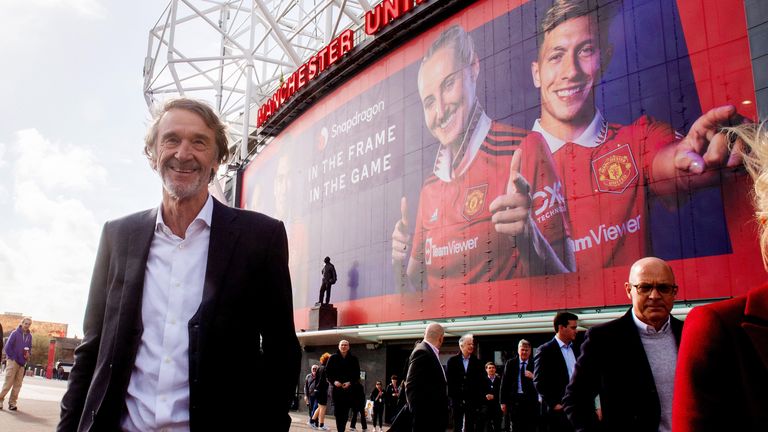
Sir Jim Ratcliffe isn’t one to shy away from big projects. That’s why he wants to knock down Old Trafford, the largest stadium in British club football, and build the – even larger – largest stadium in British club football.
It’s an ambition that divides opinion, but one that has to be viewed in the wider context of football finance. The Premier League’s new Profitability and Sustainability Rules (PSR) have thrown the cat among the big-spending pigeons. Suddenly, it’s not quite enough to have a shady oligarch or entire shady country bankroll your squad’s facelift. Revenue is king. Without enough of it, clubs are presented with an unenviable fork in the road: scrimp, or suffer a points deduction.
Old Trafford doesn’t exactly have a problem with matchday revenue – its 75,000 capacity is comfortably the highest in the league – but it’s an old stadium with mounting issues. Its roof is as leaky as United’s defen- oops, that one’s been taken. Rust and wear runs through the brickwork as much as it does the United squad (that’s more like it). Missing out as a host stadium at Euro 2028 to the noisy neighbours’ Etihad stadium underlines the ageing process of the England national team’s second home – used only once since the ‘new’ Wembley opened in 2007.
Convenient then that Ratcliffe recently declared his flagship construction project as the ‘Wembley of the North’. This managed to screw up quite a few mancunian faces, with the Oldham native not quite grasping his supporters’ self-identity in opposition to the wealth-hoarding capital city. Nevertheless, the tagline for a new 90,000 seater seems to have stuck.
The justification given by Britain’s richest man is unsurprisingly about money. It would help to make up ground lost to the league’s recent renovators. Tottenham, Arsenal, West Ham and the aforementioned Man City profit from modern, well-connected, multi-purpose stadia which can host visitors like Lady Gaga and Beyonce – far more glamourous than Burnley and Luton Town. Evidence, such as Tottenham’s 600% increase in new stadium matchday revenue, highlights a trend towards maximising sales by keeping doors open in the hours before and after a game. The new generation of match-going fans have their whole day mapped out. That’s right, red devils, get in there early. It’s wall-to-wall craft beer and banh mi.
It’s not an unrealistic task either. Like rats, you’re never further than 5 meters from a United fan at any moment. So there’s no concern about filling the extra capacity. Nor would it do any harm to regenerate Trafford Park, an area where if I’m not attending a match or a gig at Victoria Warehouse, I must be lost.
But it’s worth considering what could be lost for good if the Theatre of Dreams is bulldozed. The saying “if it ain’t broke, don’t fix it” is probably frowned upon in architecture, but the truth is that Old Trafford continues to serve its purpose well. A leaky roof isn’t a sign of imminent collapse. Knocking the whole thing down and starting again would come with an immense cost (roughly £1.2 billion) which could otherwise be spent on improving the squad. It’s perhaps coincidence that Arsenal and Tottenham reached the Champions League final the same year their new stadiums were completed. But 2006 and 2019 marked these teams’ peak before a protracted, painstaking transition period. No more marquee signings when you need to pay off the new home.
For all their differences, I’m sure fans of Spurs and Arsenal share the sweet sorrow of latter-day White Hart Lane and Highbury. After years of routine, you take your seat at your club’s Saturday fortress for the final time. It then disappears to be replaced by a swanky mega-bowl. Despite attention to detail and a focus on acoustics, the atmosphere at Spurs felt flat during most games. Thankfully, the library comparisons had already been made with the Emirates. Although I’m now giddy with excitement at my club’s spending power, the humble quirks and mystique of White Hart Lane are still missed. Lord knows how United fans will mourn the Theatre of Dreams.
Even the most fanatical of United supporters may see their fiercest rivals as an example to follow. Like Old Trafford, Anfield is one of the remaining grand cathedrals of football. Over two rounds of redevelopment spanning ten years, its capacity kept pace with the league’s leaders, growing from 45,000 to 61,000. Kopites therefore don’t have to worry about losing what is such a core component of Liverpool’s identity and ethos.
Good for them. But for all its aches and pains, moving home is an inevitability in football as it is in life. Time swallows everything, including the steelworks of your football club’s main stand. Old Trafford’s best days are far behind us, so a new stadium for a new era makes sense – you don’t need a marketing degree to see that. Ratcliffe, in the spirit of ruthless modernisation (and self-congratulation), will choose to build. Fans are understandably sentimental folk but if they had their way, would any of the decaying stadiums of the 20th century be replaced? We’d still be sat in wooden chairs drinking Bovril.
Now, where’s my pint of Neck Oil?
 Chris Perrin
You must be logged in to post a comment.