
Time moves way too quickly in football.
On Christmas Day, Arsenal were top of the Premier League having earned a more-than-respectable point at Anfield. ‘Top at Christmas’, a purely symbolic accolade, is nonetheless a firm indicator that a team are title contenders.
Fast forward two weeks from Christmas. Arsenal have lost all three games they have played, scored just once, and are engulfed in a ‘crisis’. A small, forgetful minority of Arsenal fans (presumably the ‘Amnesiac Army’) are calling for Mikel Arteta’s head.
I’m a Tottenham fan, so Arsenal’s long-overdue meeting with cataclysm does, in one sense, fill me with joy. And I could jump on the bandwagon. Yes, definitely sack Arteta! Get rid of Bukayo Saka too, he’s useless!
But I also observe this with intrigue and empathy. Arsenal seem to be suffering a case of ‘near-success syndrome’.
1: what crisis?
At present, the press is rife with criticism of Arsenal, as well as reasons and remedies for their recent failings. ‘We need a killer’, says Ian Wright, essentially describing himself in the 1990s. Arsenal have ‘killed William Saliba’s love for the game’, speculate Sport Bible with just a hint of exaggeration. Even Arteta himself fears his attackers have ‘mental block’.
Reactions like these aren’t unfounded, but they are overblown. Arsenal are obviously having issues in front of goal, but at Christmas, i.e. three games ago, Arsenal had scored 36 PL goals in total – just one fewer than Liverpool and four fewer than Manchester City. They also had the joint-second best goal difference in the league, and had scored 3+ goals on seven occasions in all competitions.
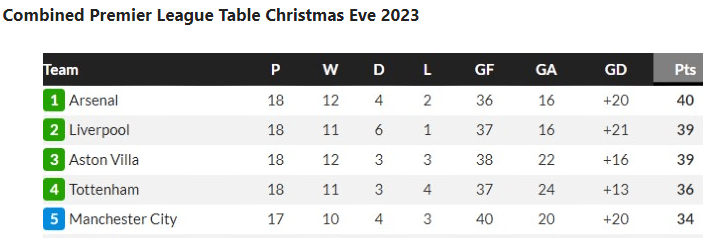
So clearly then, it wasn’t long ago when Arsenal’s supply of goals was healthy, and helped by their defence keeping it tight at the other end of the pitch.
And yet I was led to believe that Arsenal’s forwards couldn’t hit a barn door and that, given the circumstances, paying £100 million for Ivan Toney was ‘sensible’ and ‘the price of success these days’. That’s not to speak disparagingly of Toney, who I would take at Spurs in a heartbeat. But for that money, it would be the kind of short-sighted deal for a player who hasn’t kicked a ball in eight months that invariably backfires.
The situation at Arsenal still feels quite disastrous though, doesn’t it? Even if it probably isn’t.
2: last season was mad close
Perhaps the cause of this malaise is the psychological impact of near-success.
We need to remember how good Arsenal were for so much of 2022/23 before, tragically, ending the season trophy-less.
At Christmas last year, Arsenal had taken 37 points from 14 games. That’s points dropped in just two matches. They were comfortably the league’s best team for eight out of ten months. For the first time since 2013/14, Spurs were beaten home and away by their North London rivals. The 0-2 at our place was one of the biggest NLD non-contests I can remember.
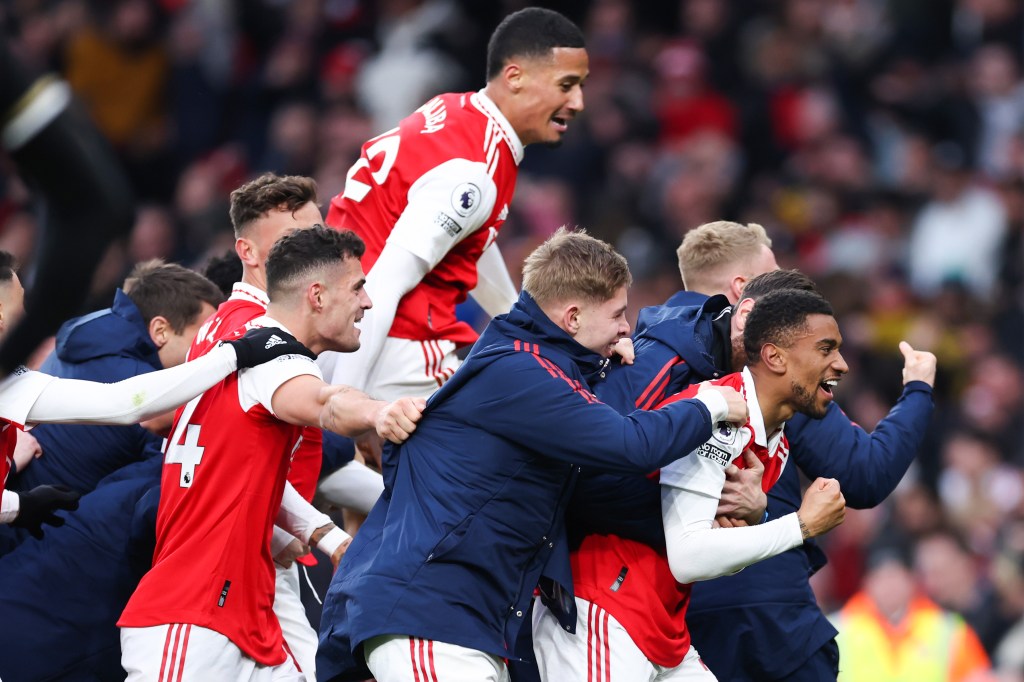
The bottom line is, Arsenal hit terminal velocity and practically every single squad member was playing out of his skin. They were dancing their way to success to the tune of the Saliba chant.
But that success never came. We all know what happened and sadly for the Gooners of this world, it wasn’t even that big a down-turn in results. ‘Bottlers’ is an overused term, and does not apply to Arsenal in 2022/23. It’s nigh-on impossible to win every game, and invincibility is – well, I’ll stop right there.
No one can say Arteta stood still in the summer either. The state of his squad was, on paper at least, stronger in August than it had been in May. The £100 million spent on Declan Rice looked to be (and still could be) the difference between first and second.
But no amount of money can pay off the psychological deficit Arsenal plummeted into last season. I say this because it must be so challenging, even for the hardiest of athletes, to reach what is seemingly your absolute best and still stop short of victory. More so in a collective sport where there are additional parts involved.
3: empathy
Let’s put it this way: I have been conditioned to block out anything close to a positive thought about Arsenal. Yet it was hard not to like their team. Bukayo Saka was England’s best performing player. Martin Odegaard, rejected by Real Madrid, had fulfilled his huge potential which for years looked misplaced. Reiss Nelson scored one of the great last-minute winners against Bournemouth, and my feelings of contempt and dread (it had the air of a title-winning moment) were strangely mixed with admiration. What a goal and what a moment.
I mentioned empathy before, and I did so because Tottenham have experienced similar. In the 2018/19 season, my team looked to have performed every possible footballing miracle to reach the Champions League final. It was such a pinch-yourself scenario – the kind of pie in the sky ambition you never think is actually going to happen.
As brilliant and unexpected that journey was, I look back on it with a bitter sweetness that poses the same question Arsenal currently ponder. How do you better your best?
What followed, after the loss, was the worst kind of comedown: intense and long-lasting. Many of the players who were instrumental during Tottenham’s run to the final were shadows of their former selves. We were, let’s face it, rubbish, and continued to be rubbish for another four years. From the starting XI in the CL final, only Heung-min Son is still at the club. The manager lasted four months. There’s no doubt about the mental toll that the defeat took on the squad and staff, and some former players have attested to this.
4. monkeys and elephants
There are two possible prizes for second place. One is hope, the dream of going one further in the future. The other is an existential crisis, at the core of which is the anxiety that you’re at the ceiling and can go no higher. Arsenal started this season with the former, but risk allowing the latter to take over with this dip in form. There’s a monkey on their back and it needs to be shaken off quickly.
But more important than the monkey in this room is the big, sky-blue elephant: Manchester City.
Last season, Arsenal were the latest in a line of unsuccessful rebels to contest City’s Premier League hegemony, which has stood since Pep Guardiola’s first of five titles came in 2018.
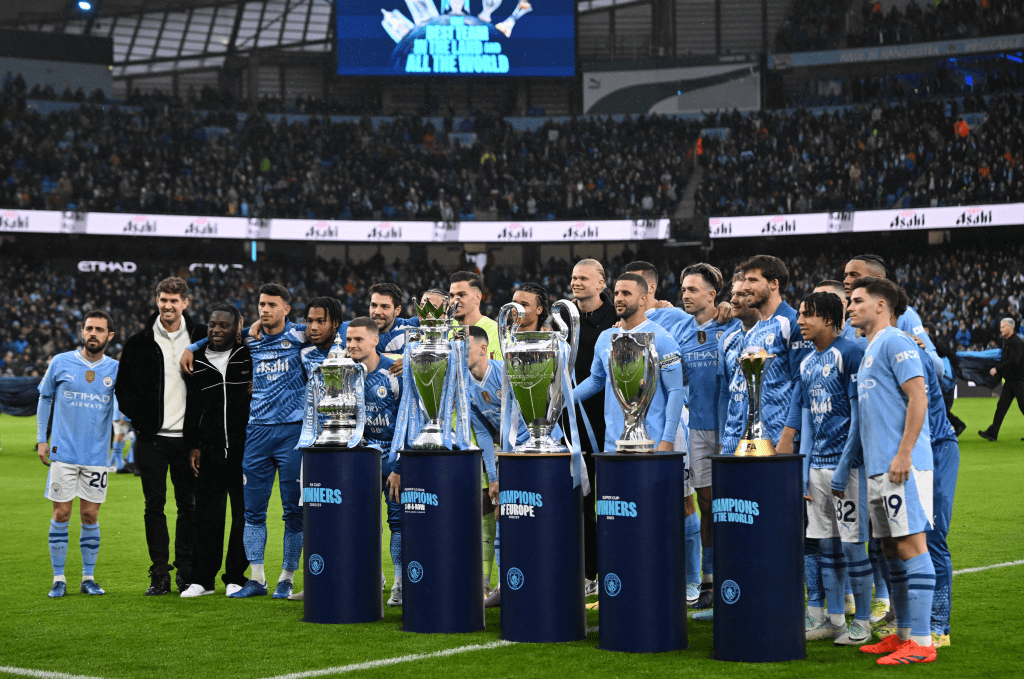
There is a more devastating complexion to City’s dominance than anything Sir Alex Ferguson ever built with his great Manchester United teams. United, even during their two Premier League peaks, traded blows with other clubs – mainly Wenger’s Arsenal and Mourinho’s Chelsea – and were knocked down. Never did United’s power appear absolute. With City, who flaunted five major trophies to their faithful at the end of 2023, it feels different.
You can view Guardiola’s City in one of two ways. There’s the Star Trek version, which is a vision of Man City as a vessel of football discovery, going where no team has gone before, constantly innovating the tactical rules of the game. Full-backs are wingers. Full-backs are midfielders. Full-backs are centre-backs. Centre-backs are midfielders. ‘We cannot replace him’, so Sergio Aguero for some time is not replaced. Then the False 9 becomes the Most 9 you can get, and Erling Haaland subsequently elevates City to an even higher level.
For the more cynical among us, there’s the Star Wars vision. Pep, obviously, is Darth Vader. The Death Star represents the City Football Group, using its endless resources – harvested from an ethical minefield – to mow down the rest of the footballing galaxy. The fact that Guardiola mentored Arteta makes this even more of a compelling analogy – Mikel, I am your father.
Manchester City’s stranglehold of English football is such that it would take something miraculous to dethrone them, which Arsenal so nearly conjured up. But if you shoot for the king, you best not miss.
Arsenal are, right now, hyperconscious that their best chance to do that may have passed. That realisation has tainted what was otherwise an assured first half of the season. How they manage the crisis from here will have a huge bearing on the second half. Use the force, Mikel.
 Chris Perrin