
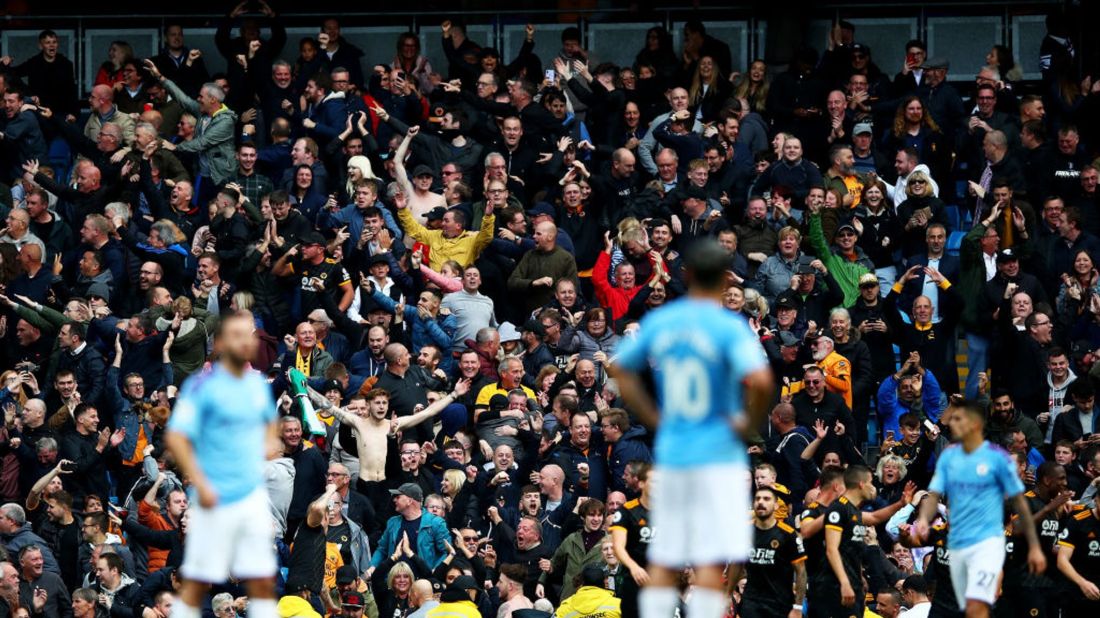
The fifth Tottenham penalty was saved, and they were out of the FA Cup. All the players headed down the tunnel, but for one exception. England international Eric Dier, incensed, jumped the hoardings to enter the crowd. He hurdled over rows of seats to confront a fan (sat near members of Dier’s family) from whom he had received abuse during the game. Such an incident at the highest level of English football hadn’t been seen since Eric Cantona infamously kicked out at a Crystal Palace supporter in 1995 . Although in this case it did not succumb to violence, Dier’s actions were widely condemned as reckless and unprofessional. Former Spurs midfielder Danny Murphy wrote, “if supporters go to the match as a break from the other difficulties of life, they do view it as a place where they can vent frustrations. As a footballer, get on with the game, do your job.”
Can we say, sing or shout anything we want in view of a football pitch?
The first obvious response is, well, not anything. It is certainly worth stipulating the obvious exceptions to free expression. Discriminatory language – racism, homophobia, sexism – is of course beyond the realm of debate, and can incriminate anyone who uses it.
This still leaves much to be considered in a milieu where so many act in a manner they wouldn’t elsewhere. Eric Dier was not the victim of racism or homophobia. Rather, just very tough criticism and strong language. This is the sort of thing many would excuse as being ‘part and parcel’ of the sport. But is there a line to be drawn anywhere? That is to say, can supporters be morally culpable for their speech?
Surely not, some would argue. Football is a spectator sport after all. Supporters are paying customers, and they pay a lot – not just through money, but also the time invested following a team. A certain level of performance therefore ought to be expected, much like when going to a theatre or concert. Anything falling below that level can be rightly submitted to criticism. So if my central midfielder isn’t tracking back, I am very much entitled to tell him to track back. In the heat of the moment, I might even tell him or her to ‘fucking track back!’. Admittedly swearing isn’t the most courteous or pleasant way of expressing oneself. But why is it deployed? To cut through, to emphasise and intensify. It’s also a component of dark humour, which is what many football chants are. It’s why football fans sing ‘yourrrr support is fucking shit!’ instead of ‘yourrrr support could be improved!’, or other child-friendly words to that effect.
That we excuse the track back shout and the support taunt is perhaps because there is no real, countable victim or recipient. In the first instance, it could be any central midfielder. We are not shouting at the person as such. Rather, we shout at them as they happen to be in a position with a specific role to track back, which they are failing to fulfil. In the second, we inflict no harm on any individual when mocking the atmosphere generated by a large group, as any one fan’s contribution would be negligible. No one loses sleep after a match thinking, ‘if only I cheered louder today’.
Here the problem arises when shouts and chants become personal. Perhaps the least severe of such chants are those that attach an individual with a slur. Think, ‘the referee’s a wanker’ or the cry of ‘you fat bastard’ directed at a goalkeeper taking a goal kick. We may be able to justify such examples as more playful, dark humour born out of rivalry and competition. Another common defence is that players, managers and officials (albeit to a lesser extent) are privileged to have such jobs, earning handsome salaries. In no position to complain, they should therefore grudgingly accept what comes their way.
Let’s go further though. I personally remember as a seven year old at my first north London derby hearing thousands around me shout ‘sit down you paedophile!’ at Arsene Wenger, as well as a number of spiteful chants towards Sol Campbell. That’s just from my own fan base. In stadia up and down the country footballers are on the receiving end of the same sorts of chants. How can we give grounds for this? Trying to squeeze it under the umbrella of dark humour may narrowly suffice. One could possibly expand by saying that fans are a vital ingredient in making a football match spectacular. More must be done than just ‘clap clap clap clap clap, [insert team name]’. By pushing the boundaries with their chants, supporters add more bite and intensity to a game. The risk is that the cheeky and creative can so easily turn foul.
There are of course instances where no humour is intended at all. ‘Get out of this club, you useless c*nt’… ‘you’re a fucking disgrace’… the imagination can provide further examples. This is just plain abuse, but I for one would barely bat an eyelid if I witnessed it in the stands. How is it in any way normal? Perhaps it can be justified by taking into account the number of people who contribute to a chant, or more broadly a hostile atmosphere in which such insults are heard. One person saying these things may be bad, but what about fifty thousand at the same time? We may believe such a circumstance alleviates personal culpability, and thus the moral consequences of the activity itself. In other words, what is deemed right or wrong may be subject to change depending on how many people do it. One student walking across a freshly cut lawn on a university campus with a ‘do not walk on’ sign puts them at fault. If all the students decide to ignore the sign and walk on the grass, is it still wrong? We may well accept that, for better or worse, the sign is redundant and no one is really blameworthy.
This sort of anarchistic attitude of ‘well everyone does it, so I can too’ may not however be enough to provide a plausible moral account of limitless fan behaviour. What is crystal clear is that football stadiums stand alone in being the only places where this sort of abusive language exists. No other sportsperson would have to put up with abusive shouts about their appearance, personal life, or even their performance! Have your serve broken? Bad luck. Out for a duck? At worst a light groan from the pavilion.
The idea that fans need to ‘vent frustrations’ seems to serve as weak reasoning. Everyone builds up some stress in the rat race. Does this make Saturday afternoons a free-for-all to shout and swear as one pleases? Surely there is no concomitance between working all week and being a hateful arsehole at the weekend. When the bell for last orders is rang on a Friday night, there isn’t a chorus of ‘the barman is a wanker!’. The football fan is not a different breed of human. These are ordinary people with jobs and families. Why is there a separate moral code?
With so many rhetorical questions to ponder, it appears difficult to ascertain where to draw the line, if one has to be drawn at all. Though it has always been a point of concern, the past season has thrown up persistent cases of abuse from the stands. Dier’s incident may not be in isolation for much longer. When fans return to their seats, whenever that may be, they ought to reflect on how they conduct themselves.
 Chris Perrin